An address book is other people’s data: phone numbers, home addresses, birthdays, and notes about conversations. Giving an app access to it means trusting that app with everyone you know.
Most contact apps are honest about what they do, but the details differ widely. These are the questions worth asking of any of them.
Five questions to ask
| Question | Compact Contacts |
|---|---|
| Does it require an account? | No developer account or sign-in |
| Does it copy contacts to its own cloud? | No; the system Contacts database stays the source |
| Does it use analytics or ads? | No ads and no third-party analytics |
| Does it enrich contacts from the web? | No lookups or enrichment |
| Are Notes exported by default? | No; CSV never includes Notes, vCard only when you switch it on |
Read the privacy label, then test
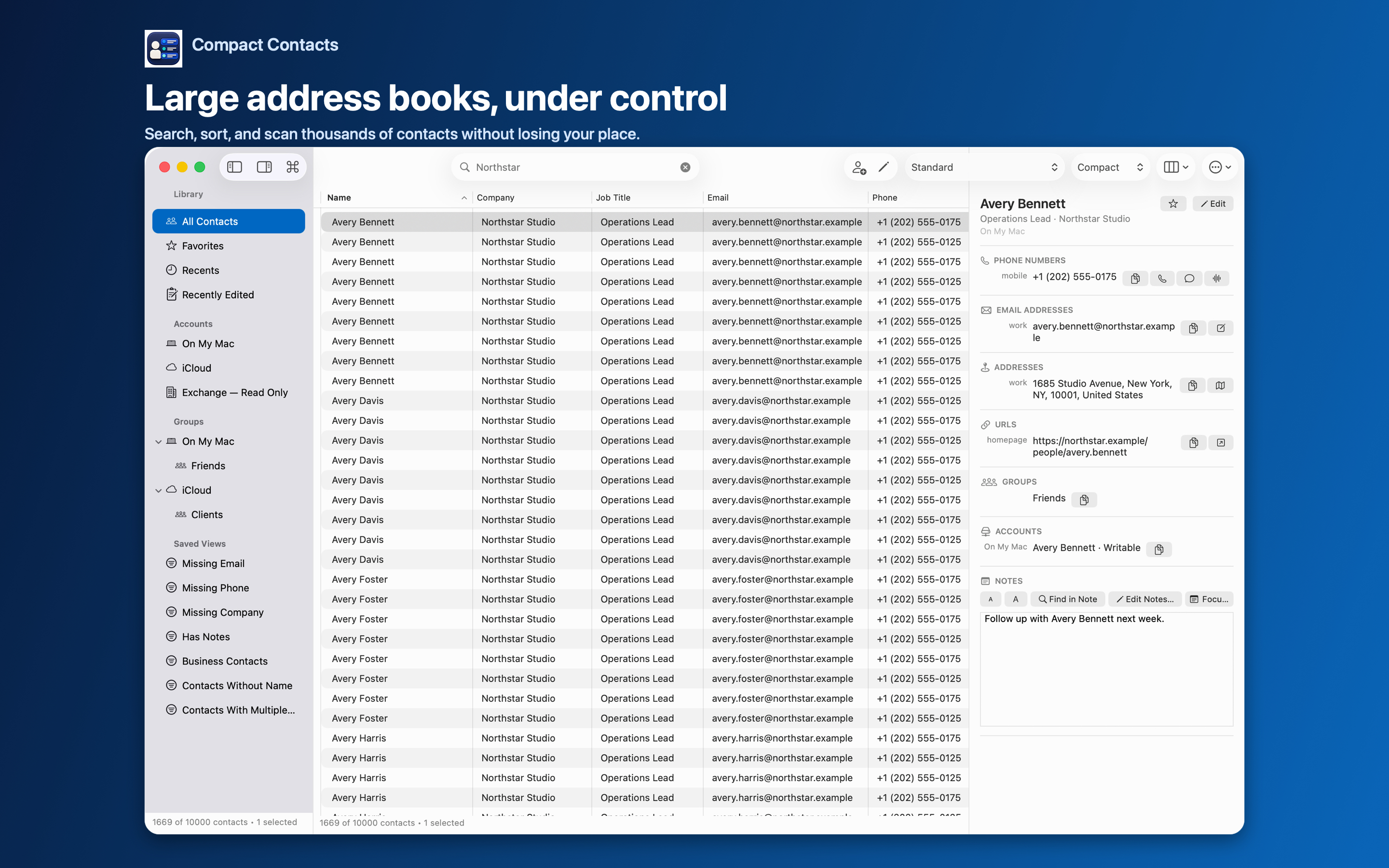
The App Store privacy label summarizes what an app says it collects. Pair it with a practical test: can you try the app without granting access? Compact Contacts includes Sample Contacts, 26 fictional records that never touch your real address book.
Also look at support. Compact Contacts support asks you not to send real names, numbers, Notes, or screenshots with personal data, and diagnostics exports are redacted.
What local does not mean
Your contacts still sync through iCloud, Google, Exchange, or CardDAV if you set those accounts up. That sync is between you and your provider; the app does not add another destination.
Questions people ask
Does Compact Contacts send my contacts anywhere?
No. Contacts are processed on your device. Files leave only when you export and share them.
Where is the Notes search index kept?
In memory on the device. It is discarded when you turn Notes search off or quit.
How is the app paid for?
A one-time purchase per platform. There is no subscription, ad, or data business.