
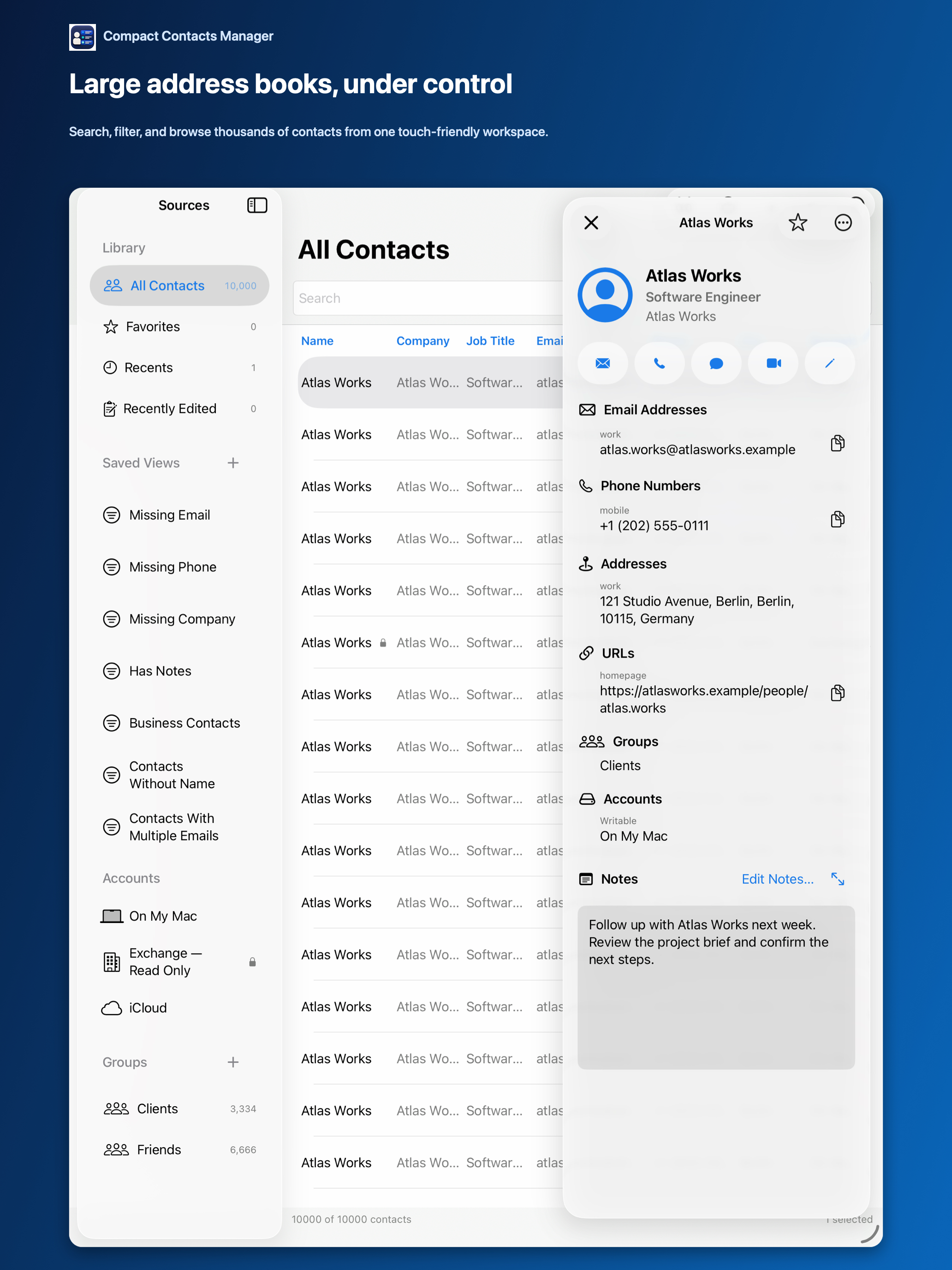
Users who organize an address book with native Contacts groups usually do not need a larger contact system. They need a clearer answer to one specific question and a safe way to act on the result.
Apple’s standard interface does not always make ungrouped records obvious, especially across multiple accounts. The practical goal is not to make every card look complete. It is to make the relevant records visible, understand which account owns them, and keep every change or handoff deliberate.
Start by defining the result
Before choosing a tool or opening an editor, describe the result in one sentence. Are you trying to find a missing field, compare several records, update one repeated value, read long context, or send a controlled subset to someone else? That definition prevents a broad cleanup from growing around a narrow need.
Keep system Contacts as the source of truth. A focused workspace can improve search, layout, filters, and previews without migrating records into a second contact cloud. Account ownership still matters because an iCloud card, a Google card, and a managed Exchange directory may allow different operations.
A practical workflow
- Define a view that checks group membership. Keep the step small enough that you can verify the result before continuing.
- Keep account ownership visible because groups belong to a specific source. Keep the step small enough that you can verify the result before continuing.
- Review the ungrouped list before assigning membership. Keep the step small enough that you can verify the result before continuing.
Recovery first: before a large edit or any deletion, create a full Contacts archive and a narrower vCard export of the affected set. A preview reduces risk, but it is not a substitute for a recovery path.
What Compact Contacts adds
Compact Contacts Saved Views can combine group and account conditions so ungrouped or differently grouped contacts are easier to review.
The app is designed around visible scope. Search runs locally; Saved Views store rules and layout rather than contact copies; bulk changes show eligible and skipped records; CSV and vCard exports show their scope and count; vCard Notes remain excluded unless you explicitly include them.
What it deliberately does not claim
Keep the boundary clear
Group membership cannot cross incompatible account containers; adding a card to a group does not move the contact between accounts.
Compact Contacts also does not operate a contact sync service, enrich people from third-party databases, run automatic background cleanup, or silently move records between accounts.
Verify the result
After an edit, re-open the affected record and confirm the exact field. When provider sync matters, check the result in Apple Contacts or on another device after the provider has had time to synchronize. After an export, open the file locally, verify the record count, and confirm that sensitive fields such as Notes are present only when intended.
Questions people ask
Is this workflow safe for a real address book?
Start with a backup, keep the scope narrow, and preview any supported edit or export. Group membership cannot cross incompatible account containers; adding a card to a group does not move the contact between accounts.
Where does Compact Contacts store the real contact?
The system Contacts database remains the source of truth. Compact Contacts stores app preferences such as Saved Views, not a developer-hosted contact copy.
Does this change how iCloud or another provider syncs?
No. macOS, iPadOS, and the configured provider continue to manage synchronization and account capabilities.